Quite suddenly, I had a hankering for sweet and sour pork. And I
know myself enough that it's better to just get it over with than deny
it... so here it is -
I
remember that this is one dish that I was allowed to cook (at age 11 or
12 if I remember correctly). I was given very, very specific
instructions to have everything prepared before cooking. It is a
practice that I've kept (with very few exceptions)...
My mise en place -
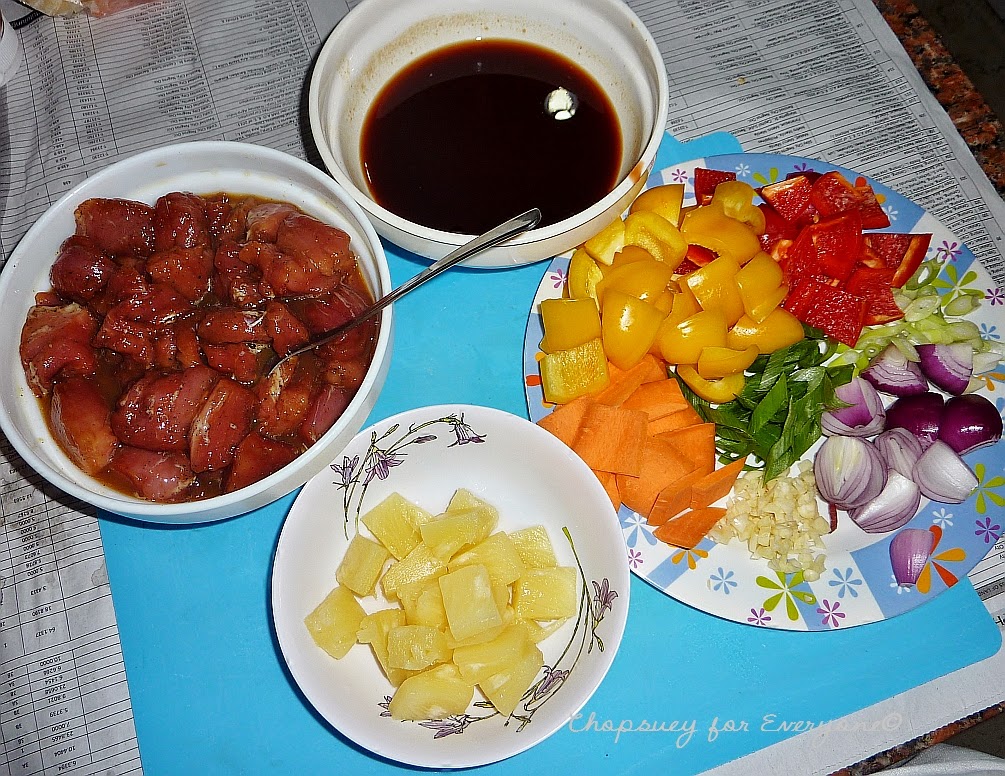
As expected, my craving was sufficiently satisfied.
The recipe (adapted slightly from Yan Kit's Classic Chinese Cookbook
800 grams pork tenderloin, cubed
2 teaspoons light soy sauce
1 egg, slightly beaten
1/3 cup cornstarch (I used AA powder)
2 cloves garlic, chopped up
1 medium onion, skinned and chopped coarsely
1 red bell pepper, seeded and diced
1 yellow bell pepper, seeded and diced
1 small carrot, sliced into "squares"
100 grams canned pineapple chunks, drained, juice reserved
Sauce:
1 tablespoon cornstarch dispersed in 1/2 cup water
1/4 cup pineapple juice (reserved from pineapple chunks)
3 tablespoons white vinegar
1/4 cup sugar (I would use a little less)
1/4 teaspoon salt (or to taste)
1 to 3 tablespoons light soy sauce
2 tablespoons tomato ketchup
1 teaspoon Worcestershire sauce (optional, I always skip this)
leeks, for garnish
Marinate
pork cubes in soy sauce for about 15 to 30 minutes. Stir in enough of
the beaten egg to coat the pork cubes, then dredge the pork, piece by
piece, in the cornstarch (enough to coat but not excessively).
Deep fry the pork, separating the pieces in the wok. Drain on paper towels.
Stir
together all ingredients for the sauce. Adjust seasonings (this is
important because different brands/spices have subtle differences)
Saute
the garlic and onion until soft. Add the green pepper and stir fry
until pepper is almost cooked. Add the pineapple chunks.
Lower the flame and add the well stirred sauce. Heat (over low flame) until boiling. A dd the pork cubes. Serve immediately.
(to make the pork crispy, deep fry again before adding to the sauce)
Final Note: different brands of soy sauce have varying degrees of saltiness. Adjust accordingly.
Showing posts with label sour. Show all posts
Monday, July 7, 2014
Tuesday, August 20, 2013
Sinigang na Salmon
We've been having rainy days. And when the weather is wet and cool, we love comfort foods.
Sinigang is one of the greatest comfort foods I know. There's just something about a hot, spicy and soup broth that feels homey. Mmmmm...
There are many variants of sinigang. By "meat" - pork, chicken, beef, fish, shrimp, or even the lack thereof - vegetarian. By souring agent - bayabas (guava), sampaloc (tamarind), hilaw na mangga (green mango), kamias (I have no idea what this is in English), kalamansi (Philippine lime) and santol (another one whose English name I don't know). By far the most common is pork and sampaloc, although bangus (milkfish) is a close contender.
The sinigang of my childhood is one made from scratch (by boiling sampaloc in water, mashing it when cooked and straining everything in another pot of water, usually with gabi boiled in it and softened), but these days, there's a multitude of instant sinigang mixes that is simply added to water and voila! sinigang in a few minutes even without anything in it.
But in my book, sinigang is always with sampaloc and gabi (taro), tomato, sitaw (long beans), and kangkong (swamp spinach/cabbage). My absolute favorite is shrimp!
Yesterday, I had a longing for sinigang with salmon, specifically salmon belly. Unfortunately, I only found the head and tail. But tides turned in the afternoon when the salmon belly (figuratively) fell into my lap!
Here's the recipe:
sampaloc, prepared as indicated above OR
instant sinigang mix (for 2 liters of water)
1 piece salmon head and tail (came in a set)
1 pack salmon belly (about 8 to 9 "strips")
gabi (we like a lot of these)
1 large Spanish onion
2 medium local tomatoes
sitaw (1 bundle)
okra, sliced (discard ends)
sili (finger chili)
kangkong (2 bundles)
Prepare the souring agent (cook, mash and drain fresh sampaloc) or dissolve instant sinigang in a little water. Boil the gabi to desired "softness".
Clean the head, tail and belly.
Saute the onion until caramelized, add the tomatoes. Pan fry the fish for several seconds. Pour in the gabi with boiling liquid, souring agent, and top up to make about 2 liters total. Add the sitaw, sili and okra and simmer until quite done. Throw in the kangkong, cover the pot and remove from heat.
Here's our sinigang:
Yummy! And yes, very comforting...
There are many variants of sinigang. By "meat" - pork, chicken, beef, fish, shrimp, or even the lack thereof - vegetarian. By souring agent - bayabas (guava), sampaloc (tamarind), hilaw na mangga (green mango), kamias (I have no idea what this is in English), kalamansi (Philippine lime) and santol (another one whose English name I don't know). By far the most common is pork and sampaloc, although bangus (milkfish) is a close contender.
The sinigang of my childhood is one made from scratch (by boiling sampaloc in water, mashing it when cooked and straining everything in another pot of water, usually with gabi boiled in it and softened), but these days, there's a multitude of instant sinigang mixes that is simply added to water and voila! sinigang in a few minutes even without anything in it.
But in my book, sinigang is always with sampaloc and gabi (taro), tomato, sitaw (long beans), and kangkong (swamp spinach/cabbage). My absolute favorite is shrimp!
Yesterday, I had a longing for sinigang with salmon, specifically salmon belly. Unfortunately, I only found the head and tail. But tides turned in the afternoon when the salmon belly (figuratively) fell into my lap!
Here's the recipe:
sampaloc, prepared as indicated above OR
instant sinigang mix (for 2 liters of water)
1 piece salmon head and tail (came in a set)
1 pack salmon belly (about 8 to 9 "strips")
gabi (we like a lot of these)
1 large Spanish onion
2 medium local tomatoes
sitaw (1 bundle)
okra, sliced (discard ends)
sili (finger chili)
kangkong (2 bundles)
Prepare the souring agent (cook, mash and drain fresh sampaloc) or dissolve instant sinigang in a little water. Boil the gabi to desired "softness".
Clean the head, tail and belly.
Saute the onion until caramelized, add the tomatoes. Pan fry the fish for several seconds. Pour in the gabi with boiling liquid, souring agent, and top up to make about 2 liters total. Add the sitaw, sili and okra and simmer until quite done. Throw in the kangkong, cover the pot and remove from heat.
Here's our sinigang:
Yummy! And yes, very comforting...
Subscribe to:
Posts (Atom)


